MitoScore®
When it comes to mitochondria, less is more.

Mitochondria are the “power plants” of all eukaryotic cells (cells with nuclei). With few exceptions, children inherit their mitochondria from their mothers only.
Ms. Odell reviewed the report of Pre-implantation Genetic Testing for Aneuploidies (PGT-A) from the Igenomix®. She wonders what a MitoScore® is.
A MitoScore® is the ratio of mitochondria DNA (mtDNA) to nuclear DNA. Mitochondria are structures inside all living eukaryotic cells. They produce energy to support cellular functions. Their DNA, mtDNA, is different from the nuclear DNA. The former is present inside the mitochondria, and the latter, in the nucleus of a cell.
Depending on the total energy output of mitochondria and the energy demand of a cell, mitochondria may multiply. Since the nuclear DNA stays the same when a cell is not duplicating, the number of mitochondria in a cell can be expressed as the ratio of mtDNA to nuclear DNA.
Based on a retrospective study, the likelihood of implantation of 72 blastocyst was stratified based on their MitoScore®. The table below shows a lower score is associated with a higher probability of implantation, and an extreme high score, such as higher than 60%, predicts implantation failure.
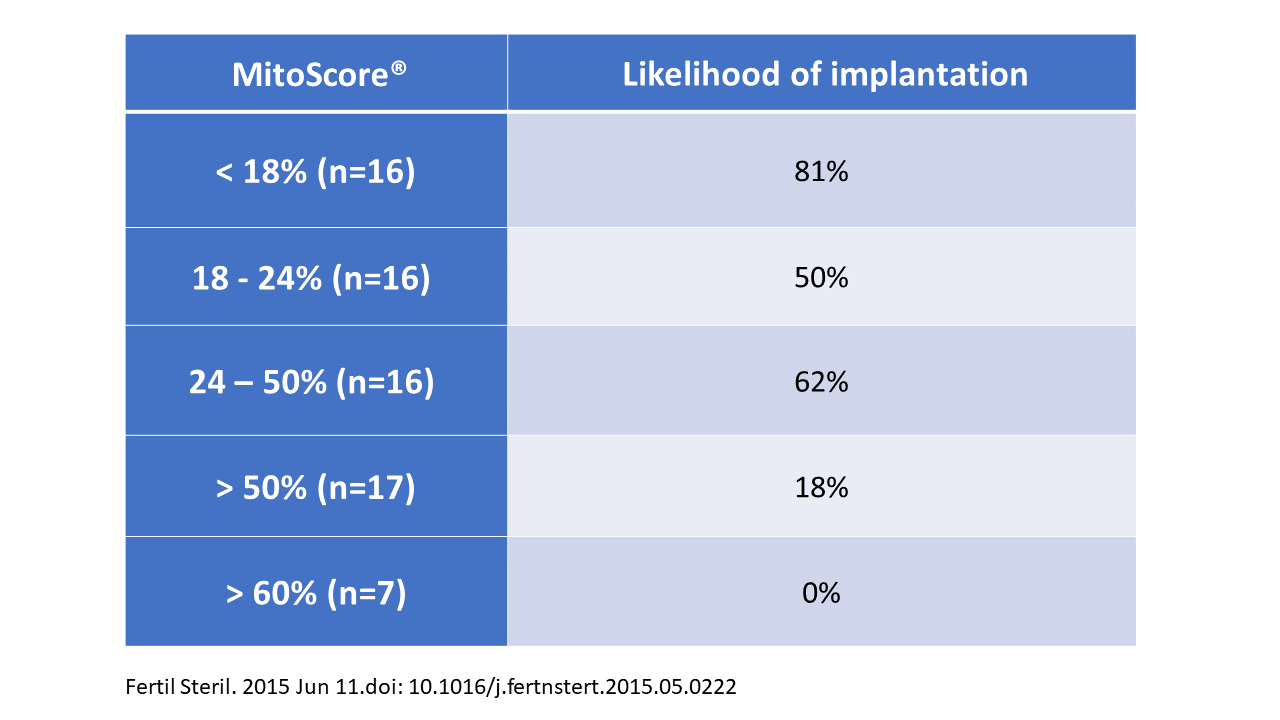
Results from later studies are conflicting. Thus, the value of using MitoScore® as a single predictor of the implantation potentials of an embryo is still to be proven.
Nevertheless, the above results are in line with the current understanding of mitochondria and the well-being of a cell. But, why do “healthier” embryos have lower mtDNA to nuclear DNA ratios?
Being the “power plants” of all living eukaryotic cells, mitochondria supply sufficient energy to meet the demand of cells. Plausible explanations include not-so-healthy cells require more energy to stay alive, mitochondria in the not-so-healthy cells produce less energy than their counterparts in healthier cells, or both. As a result, the well-being of a cell is inversely related to the number of mitochondria.
Thus, when assessing the “quality” of an embryo, the fewer mitochondria the better.